

Alright, as requested, I will create a professional, in-depth, well-structured article based on the provided reference content.
The King Under the AI Computing Wave: SK Hynix's Rise and Global Layout
Keywords: SK Hynix, American Depositary Receipt, HBM, AI Computing Power, Semiconductor, Samsung Electronics, Capacity Expansion
Introduction: From Follower to Leader
In the global semiconductor landscape, memory giant SK Hynix is undergoing an unprecedented transformation. Long eclipsed by Samsung Electronics, it has now not only surpassed the old giant in revenue and profit by leveraging its absolute advantage in the core AI computing component—High Bandwidth Memory (HBM)—but also taken an ambitious step in capital markets: planning to issue American Depositary Receipts (ADRs) to list on Nasdaq. These moves mark a new era for SK Hynix's own development and profoundly reflect how the AI wave is reshaping the global semiconductor industry. This article delves into SK Hynix's ambitions for US listing, its establishment of technological dominance, and its strategic capacity expansion.
I. US Listing: A Strategic Springboard in Capital Markets
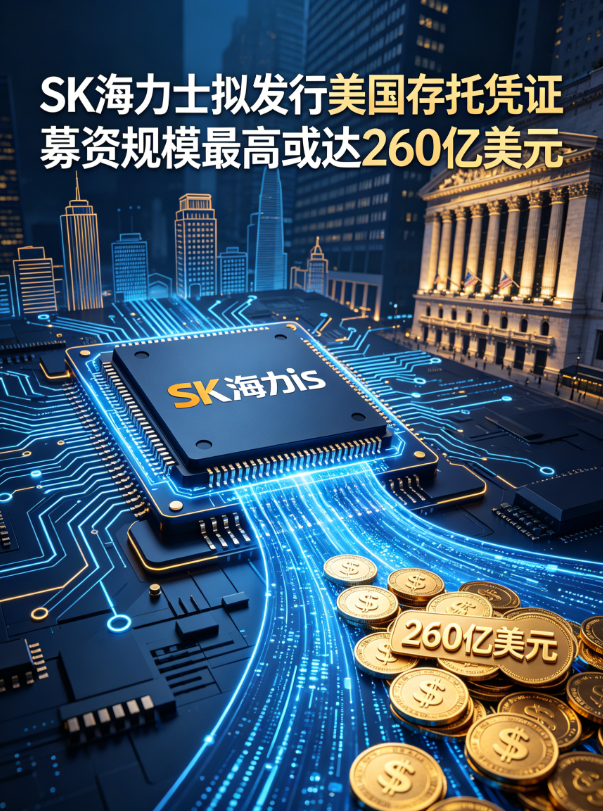
SK Hynix's plan to issue ADRs and list on Nasdaq is undoubtedly a crucial step in its globalization strategy. According to reports, the company expects to submit relevant documents to Korean financial regulators as early as July, and may even complete the listing and start trading next month. This move aims to open up broader international capital markets, directly connecting with the world's most active tech investors.
Issue Size and Market Expectations: The potential size of the ADR issue has sparked widespread market speculation. Earlier reports suggested the fundraising could reach $10 billion. However, with SK Hynix's stock surging recently due to the AI boom, its market cap once surpassed 200 trillion won, overtaking Samsung Electronics as the top stock on the Korean market. Based on this, the latest industry estimates raise the fundraising size to an astonishing 40 trillion won (about $26 billion). Regardless of the final number, this will be one of the largest equity financings in the tech sector in recent years, reflecting extremely high market expectations for its future growth.
Listing Path and Strategic Intent: The specific operational path is that SK Hynix plans to first issue shares in Korea and deposit them with the Korea Securities Depository, which will serve as the underlying securities for ADRs issued in the US. This dual-layer structure leverages the Korean domestic market while allowing international investors to trade in US dollars. Choosing Nasdaq means SK Hynix is trying to benchmark itself against global top tech companies like Nvidia and Micron, seeking higher valuation premiums and a broader investor base. This is not just about fundraising but also a global enhancement of brand and credibility, providing a solid capital backing for subsequent technology R&D and capacity expansion.
II. Surpassing and Aftermath: Brief Crown in Market Cap and Full Explosion of Performance
On June 22, 2025, a historic moment arrived: SK Hynix's stock price once surged to 2.95 million won, pushing its total market cap above 208 trillion won, briefly surpassing Samsung Electronics, which had held the top spot on the Korean stock market for 26 years. Although this record has since fluctuated, its symbolic meaning is immeasurable—it marks that in the AI-driven new era of memory, technological focus and product leadership have replaced traditional scale effects as the core measure of corporate value.
Explosive Performance Growth: This market cap leadership is not built on thin air but on solid and stunning financial data. According to SK Hynix's latest Q1 2026 earnings report, the company achieved record-breaking performance:
- Revenue: 52.58 trillion won, up 198% YoY.
- Operating Profit: 37.61 trillion won, up 405% YoY, a record high for the fourth consecutive quarter, with an operating margin of an astonishing 72%.
- Cash Flow: Operating cash flow of 26.43 trillion won, with ample cash and short-term financial assets.
Particularly noteworthy is that for the full year 2025, SK Hynix, leveraging its absolute advantage in the HBM market, recorded an annual operating profit of 47.2 trillion won, surpassing Samsung Electronics for the first time. This milestone achievement directly translated into generous rewards for employees: in February 2026, the company decided to pay performance bonuses equivalent to 2964% of base salary, averaging about 140 million won per person (about $64,000-69,500). This is not just an incentive but also a strong confidence in maintaining technological leadership and high growth momentum.
Technological Dominance: Core Infrastructure of the AI Era: The fundamental reason for SK Hynix's success is its precise positioning at the key link of AI computing infrastructure construction. Its HBM (High Bandwidth Memory) is a core component of AI acceleration systems from Nvidia, Google, and others. In early June, Nvidia confirmed the HBM4 supplier for its next-generation Vera Rubin AI platform, and SK Hynix was unsurprisingly selected, sharing this piece of the pie with Samsung Electronics and Micron Technology. Moreover, the company has successfully supplied 12-layer HBM4E samples to major customers, continuously consolidating its lead in next-generation ultra-high-performance DRAM.
III. Expansion and Future: Accelerated Yongin Cluster
Facing "explosive" demand from AI, SK Hynix is not resting on its laurels but is carrying out an aggressive capacity expansion plan.
Yongin Cluster and Korean Government Support: At the initiative of the Korean Presidential Office, plans for SK Hynix and Samsung Electronics to build a new semiconductor cluster in Yongin are in final discussions. SK Hynix plans to build four fabs there. Most notably, the company is discussing moving the original completion date of the fourth fab from 2044 to 2034, a full decade earlier. This reflects the company's determination to seize future markets and has received strong policy and resource support from the Korean government.
Blueprint to Triple Capacity: SK Group Chairman Chey Tae-won explicitly stated that to meet the strong demand for memory chips from AI computing, SK Hynix plans to triple its wafer capacity by 2034. The specific path is to double capacity within five years (by 2031). This expansion speed is extremely rare in semiconductor manufacturing, requiring not only huge capital expenditure but also the company's technical realization capability, yield control, and supply chain management.
External Evidence of Industry Prosperity: The strong market demand also provides solid evidence for SK Hynix's expansion. Third-party institution SEMI, in a June report, sharply raised its growth forecast for global front-end semiconductor equipment market size in 2026 to 23.5%, reaching $152.2 billion. Q1 2026 global semiconductor equipment shipments hit a record high. As a major downstream equipment buyer, SK Hynix's expansion plan directly reflects the high industry boom.
Conclusion: A New King Crowned, Future Awaits
SK Hynix stands at an unprecedented historical node. From plans to list in the US, to briefly topping the market cap, to the full explosion of performance and aggressive capacity expansion, every move points to one goal: becoming the absolute king of memory in the AI era. Its success path clearly shows that in the fast-iterating semiconductor industry, precise strategic foresight, continuous technology investment, and extreme focus on a single field are far more competitive than pursuing "big and comprehensive."
Of course, challenges remain. Samsung Electronics and Micron Technology are no pushovers and are catching up; global economic cycles and geopolitical risks still create uncertainty; and whether products like HBM can sustain high profit margins is unknown. However, with its first-mover advantage in HBM, ample cash reserves, and strong support from the Korean government, SK Hynix has robust confidence to face these challenges. This is not just the rise of a single company but a landmark event in the power shift of the global semiconductor industry. In the vast wave of artificial intelligence, SK Hynix has forged a sturdy and fast warship for itself, and its future voyage is one the global tech community will watch with anticipation.