

Digital Services Tax Dispute Escalates: US '100% Tariff' Threat Impacts Global Tech and Trade Landscape
Keywords: digital services tax; Trump; tariff; tech companies; Singapore; trade friction
Introduction
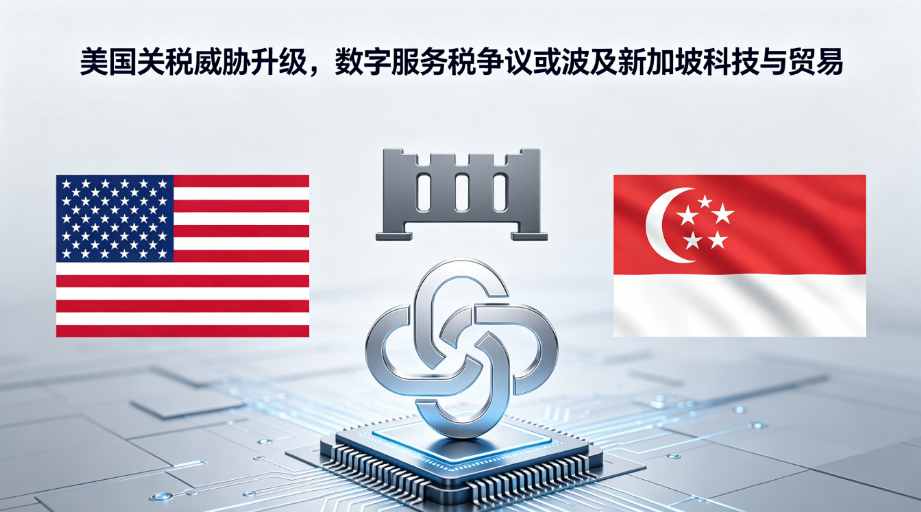
In March 2025, President Trump issued a strong warning on social media: any country that imposes a digital services tax (DST) on US tech companies will face American retaliatory tariffs of 100% on its exports to the US. This statement not only pushed the long-standing US-Europe digital tax dispute to a new sharp confrontation but also cast a shadow over the stability of global cross-border trade and tech supply chains. Although Singapore has not yet implemented a digital services tax, as an important financial, tech, and trade hub in the Asia-Pacific region, the country inevitably faces spillover impacts from this game. This article will analyze from three dimensions: the origin of the digital services tax dispute, the potential impact of US tariff threats, and Singapore's unique situation.
1. Origin of the Digital Services Tax Dispute and US-Europe Confrontation
The digital services tax essentially applies to large multinational tech companies conducting digital services activities (such as online advertising, data sales, platform commissions) within a country, collected by the country. Its original intention is to address the issue that traditional tax rules struggle to adapt to the digital economy—many tech giants have a large user base and revenue streams in multiple countries but avoid tax obligations by establishing headquarters in low-tax countries. The EU and member states like France, the UK, and Italy have been promoting digital services tax legislation in recent years, requiring US tech giants like Google, Apple, Facebook, and Amazon to pay reasonable taxes for profits obtained in local markets.
However, the US government has always considered such taxes to be discriminatory against American companies. Trump stated clearly in his statement that digital services taxes are "not a fair tax system" but "an improper punishment on US companies." He threatened 100% tariffs on all products from relevant countries exported to the US, and this measure will take precedence over existing trade agreements. The EU responded that digital services taxes apply to all qualified large digital platforms, not targeting companies from specific countries, and emphasized that maintaining tax policy autonomy is a legitimate right within the sovereignty of each country.
2. Potential Impact of US Tariff Threats: Global Tech Supply Chains and Digital Economy
Trump's tariff threat is by no means an empty threat. If the US actually implements its promise to impose 100% punitive tariffs on European countries that have implemented or plan to implement digital services taxes (such as France, Italy, Spain, UK), it will trigger a chain reaction.
First, cross-border trade costs will rise sharply. European exports to the US—from luxury goods, wine, to machinery—will nearly double in tax burden, leading to a significant decline in industrial competitiveness, and US consumers will also face higher prices. Second, the global supply chains of tech companies may be forced to adjust. Many US tech companies have data centers, R&D centers, and regional headquarters in Europe; tariff retaliation may prompt them to reassess their investment layout in Europe, possibly relocating some operations to countries that do not impose digital services taxes or have lower rates. Third, rule-making for the digital economy has hit a stalemate. The "two-pillar" tax reform framework under the OECD was already progressing slowly; the US unilateral tariff threat further weakens multilateral negotiation space, making the future of international tax cooperation more uncertain.
Additionally, financial markets and investor confidence will also be affected. Technology stock volatility, expectations of trade escalation, and rising risk aversion could trigger capital flows from emerging markets back to developed countries, exacerbating global economic divergence and instability.
3. Singapore's Unique Position: Both Risks and Opportunities
Singapore has not yet implemented a digital services tax, but its economy is highly open and relies on international trade. According to data from Singapore's Ministry of Trade and Industry, the US is Singapore's third-largest trading partner, with bilateral goods trade exceeding S$50 billion. If the US and Europe engage in a full-scale trade war over digital taxes, Singapore may face the following spillover effects:
First, the risk of supply chain adjustments by tech companies. Singapore is the Asia-Pacific regional headquarters for many multinational tech companies (such as Google, Facebook, Amazon), which are heavily involved in digital advertising, cloud computing, e-commerce platforms, etc. Once the US retaliates against European digital services taxes, the global strategic layout of these companies may be reshaped. Some regional operations or data center projects originally planned for Singapore may be delayed or reassessed. Additionally, European tech companies may reduce their digital expansion in Asia due to trade frictions, indirectly affecting Singapore's status as a digital services hub.
Second, the impact on cross-border digital trade and investment confidence. Singapore is not only a transshipment port for physical goods but also plays a key role in digital services trade. The digital tax dispute leads to chaos in global tax rules, making corporate investment decisions more cautious. Compliance costs for cross-border digital service transactions rise, potentially dampening growth momentum in related sectors in Singapore. Meanwhile, foreign direct investment in Singapore's tech sector may slow due to the deteriorating global trade environment.
Third, potential opportunities. If the US-Europe confrontation leads some tech companies to seek neutral, stable, and tax-transparent "safe havens," Singapore, with its robust legal system, efficient infrastructure, and open regulatory environment, has the opportunity to attract more multinational companies to relocate regional headquarters or digital operations. But whether this opportunity materializes depends on Singapore's ability to take initiative in digital economy rule-making and maintain policy flexibility and balance.
Conclusion
Trump's "100% tariff" threat pushes the digital services tax dispute to a new dangerous height. This dispute is no longer a simple tax issue but has evolved into a comprehensive game involving trade, technology, geopolitics, and global governance. For Singapore, although it will not be directly affected in the short term, as a small, open economy highly dependent on the external environment, it must closely monitor developments and prepare risk contingency plans in advance—including strengthening regional economic cooperation, promoting multilateral tax coordination, and optimizing its digital industry policies. In an era of increasing global uncertainty, only by maintaining strategic focus and policy resilience can one remain invincible in the storm.