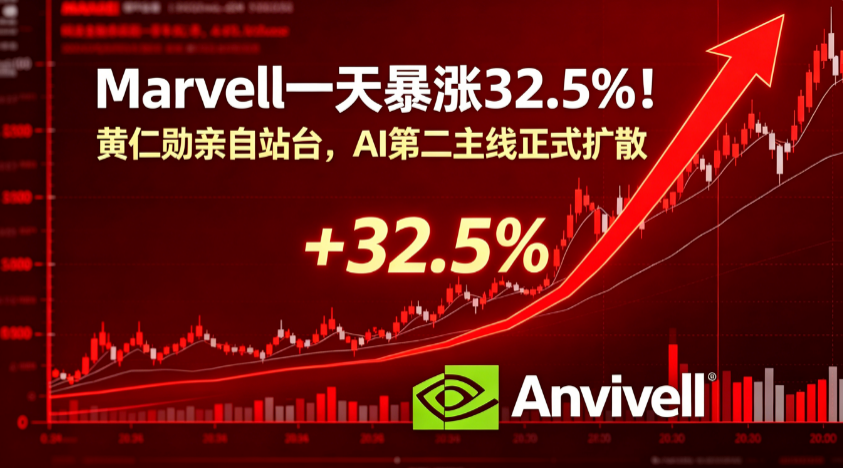


On June 2, the US semiconductor chip sector experienced a dramatic rally, with Marvell surging 32.5% in a single day, reaching a share price of $290.79 and adding approximately $62 billion in market cap. This surge was not merely driven by favorable earnings; the core catalyst was Jensen Huang's public endorsement at Computex Taipei, where he directly positioned Marvell as "the next trillion-dollar company."
Huang's statement fully ignited market sentiment and also marked the official transition of the second major AI investment theme from behind the scenes to the forefront. Over the past two years, market capital has been highly concentrated on the GPU computing track, but now the logic of the AI industry is undergoing a comprehensive upgrade: AI model sizes continue to expand, and data center cluster scales are constantly increasing. High-performance GPUs alone can no longer meet overall operational needs.
This is like having a large number of top-tier supercars but encountering a congested highway—no matter how powerful the hardware is, it is difficult to leverage. The products that Marvell is deploying—high-speed optical communication, Ethernet switching chips, custom ASICs, interconnect architecture, DSP—are precisely the "information superhighway" for AI data centers, responsible for improving data transmission speed, reducing power consumption, and lowering latency. On the surface, this stock price surge is driven by celebrity effect, but in essence, it is Wall Street re-pricing the entire AI data center industry chain and seeking the next batch of core leaders after NVIDIA.
I. In-Depth Analysis: Core Reasons for Marvell's Single-Day Surge of Over 32%
Many believe that this rally is merely short-term speculation sparked by a single remark from Jensen Huang, but this view is incomplete. Wall Street capital always enters based on a three-pronged approach of "story + performance + trend," and Marvell's breakout has multiple strong supports.
First, Jensen Huang's endorsement carries immense industry influence. Now that NVIDIA is a core traffic gateway for the global AI industry chain, being publicly named and given a trillion-dollar market cap expectation means the market is re-evaluating the company's growth ceiling. Capital clearly recognizes that AI competition is no longer limited to computing chips; data center interconnection and system collaboration efficiency will become the core tracks in the next phase.
Second, the company's financial results are impressive, with strong growth certainty. Marvell's total revenue for the first quarter of fiscal year 2027 was $2.418 billion, up 28% year-over-year; among this, data center business revenue was $1.83 billion, accounting for 76% of total revenue. The company has transformed from a general semiconductor manufacturer into a core enterprise focused on AI data center infrastructure.
At the same time, the company raised its performance guidance. The midpoint of the next quarter's revenue guidance is $2.7 billion, representing a year-over-year increase of approximately 35%. The full-year revenue expectation was raised to $11.5 billion, clearly indicating that subsequent growth will continue to accelerate. This continuously upward growth curve provides the fundamental confidence for capital to take heavy positions.
Third, custom AI chips open up long-term growth space. NVIDIA's GPUs are general-purpose computing chips, offering comprehensive performance but at higher costs; in contrast, custom ASIC chips are optimized for specific scenarios, offering advantages such as low power consumption, high efficiency, and low cost, and are highly favored by global cloud giants like Microsoft, Google, Amazon, and Meta.
Management predicts that by fiscal year 2029, revenue from the custom chip business could exceed $10 billion. The enterprise will continue to undertake large orders from cloud vendors for self-developed chips and infrastructure upgrades, providing a clear long-term growth logic.
Finally, market capital is actively shifting tracks. In the previous two years, the first major AI theme revolved around NVIDIA's GPUs. As the leader's size continues to grow, capital is seeking new investment directions. Marvell simultaneously covers three hot tracks—custom chips, high-speed networking, and optical communication—perfectly fitting the market's search for the second AI investment theme. The combination of multiple concepts has driven the stock price to soar.
II. Behind the Rally: The AI Industry Embraces a New Development Logic
Marvell's surge represents a major shift in AI investment logic: from simply competing on hardware computing power to pursuing the overall operational efficiency of the entire data center chain.
GPUs handle core computing tasks, while optical communication, switching chips, and interconnect architecture handle data flow. As AI server clusters become larger, whether data can flow efficiently directly determines the overall performance of the entire cluster. Based on this, the future AI industry chain will diverge into three clear opportunity tracks:
- Custom AI Chips: Cloud giants are reducing their dependence on general-purpose GPUs, and developing proprietary chips is becoming a trend;
- High-Speed Optical Communication and Interconnection: Technologies such as 800G, 1.6T, DSP, silicon photonics, and CPO comprehensively address data transmission bottlenecks;
- AI Servers and Network Equipment: Large AI clusters drive new network architectures, making system collaboration capabilities a core competitive advantage.
This rally is not the end of the AI boom but a signal of theme expansion. In the first phase, capital pursued computing power; in the second phase, capital focuses on system efficiency and infrastructure. The value of the entire industry track is being redefined by the market.
III. Industry Chain Breakdown: Core Targets Likely to Attract Capital Next
Following the second AI theme, we sort out related beneficiary companies by sub-sector, divided into four categories:
1. Custom ASIC Leader: Broadcom
Broadcom has deep technical expertise in custom AI chips, network switching chips, and data center interconnection, with strong customer stickiness and a stable business model supplemented by software business synergy. As a mature leader in the track, its certainty is prominent, but current valuations are relatively high, and future performance requires sustained order and earnings realization to support it.
2. Advanced Manufacturing Core: TSMC
Whether it is general-purpose GPUs, custom ASICs, or various interconnect chips, advanced processes and advanced packaging all depend on TSMC. The diversification of AI chip types further enhances its capacity value. The company has a stable industry position and a relatively steady trend, but it is easily affected by external factors such as geopolitics, exchange rates, and capital expenditures, resulting in relatively weaker stock price elasticity.
3. High Elasticity Optical Communication Targets: Coherent, Lumentum
AI data centers are gradually phasing out traditional copper cables, making optical communication a must-have track. These companies have extremely strong stock price elasticity. Once the industry logic is confirmed, capital inflows quickly, but at the same time, volatility is high, and they are significantly affected by order cycles, market competition, and inventory, making them more suitable for trend trading.
4. AI Network Equipment Manufacturers: Ciena, Arista Networks
Large AI clusters drive network architecture upgrades. Arista is deeply involved in data center switches and cloud network ecosystems, while Ciena focuses on optical networks and transmission equipment. Both have clear logic, but their rally potential is relatively weak, and stock price gains rely heavily on actual order fulfillment. It is recommended to add them to the watchlist and wait for pullbacks and earnings verification.
Overall, the above companies are all in the main track of AI capital expenditure expansion. However, a good track does not guarantee a one-way uptrend. Currently, most stocks in the sector have already priced in optimistic expectations. Subsequent stock price differentiation will intensify, and orders, revenue, and profit will become the core criteria determining trends.
IV. Practical Suggestions: Strategies for Ordinary Investors
Faced with Marvell's single-day surge of 32.5%, many investors are easily swept up by short-term emotions and blindly chase highs, which is also one of the most common pitfalls in investing. Based on current market characteristics, here are clear operational ideas.
1. Distinguish Between Short-Term Sentiment and Long-Term Industry Logic
A single-day gain of over 30% is the result of fundamentals + short-term sentiment working together. Jensen Huang's endorsement and strong earnings solidify the long-term logic, but a large amount of speculative capital entering the market will inevitably lead to profit-taking pressure later. Avoid buying in at the market's peak of sentiment with full positions.
2. Build Positions in Stages, Control Entry Rhythm
It is recommended to split the position into three parts and lay out in a gradual manner:
- Probe Position: Allocate 20%-30% of the total position. Wait for the stock price to pull back, stabilize at key support levels, and volume to return to normal before entering, prioritizing the establishment of an observation position;
- Add Position: Wait for earnings verification. If data center business and AI-related revenue continue to grow strongly, the company raises guidance, and the stock price pulls back without breaking support, then add positions opportunistically;
- Main Position: Wait for order fulfillment, revenue and profit realization, and confirmation that the company's long-term development goals remain unchanged. Only after fundamentals are fully confirmed, allocate the main position.
A single large bullish candlestick is not sufficient reason to take a heavy position.
3. Strictly Set Risk Management Rules
- Short-Term Trading: If the stock breaks below key breakout platforms or a single trade loss reaches 8%-10%, decisively reduce positions to stop losses, strictly adhering to trading discipline;
- Medium to Long-Term Allocation: No need to monitor the market excessively. Focus on tracking three core indicators: Marvell data center revenue growth rate, progress on the 2029 target of $10 billion in custom chip revenue, and demand realization in the optical communication and high-speed interconnect tracks. If the logic remains unchanged, hold for the long term.
4. Portfolio Allocation to Diversify Risk
Adopt a "core position + offensive position + cash position" combination model:
- Core Position: Allocate to established leaders like NVIDIA, Broadcom, and TSMC, which have strong resistance to volatility, as the foundation;
- Offensive Position: Allocate a small portion to high-elasticity targets such as Marvell, optical communication, and network equipment to seek excess returns, strictly controlling the proportion;
- Cash Position: Maintain sufficient cash to wait for high-quality buying opportunities after stock price pullbacks.
The truly comfortable entry points in the AI sector often come after the initial surge, when market sentiment cools, and fundamentals continue to be validated.
V. Full Summary
Marvell's single-day surge of 32.5% is a clear signal of the full expansion of the second major AI investment theme. AI investment has moved beyond the phase of solely speculating on GPU computing power. Infrastructure tracks such as high-speed interconnection, optical communication, custom ASICs, and data center networking have become new market focuses.
The track opportunities are real, but investment success depends on entry timing and position discipline. Understanding industry trends, maintaining a rational mindset, and implementing risk management and position control are essential to seize opportunities and avoid risks in this AI industry rally.