SK Hynix Q2 Operating Profit Surges 557% YoY, AI Chip Demand Drives Record High
Introduction
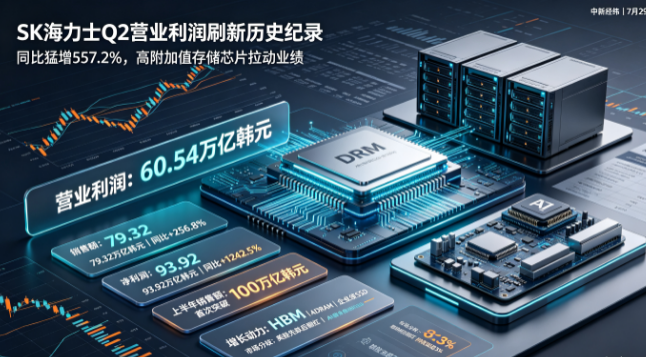
Against the backdrop of cyclical adjustments in the global semiconductor industry, South Korean chip giant SK Hynix delivered an impressive performance driven by strong demand in the AI era. According to a report by Yonhap News Agency on July 29, SK Hynix's second-quarter earnings report showed that on a consolidated financial statement basis, the company's operating profit for the quarter reached 60.5426 trillion won (approximately 2816.8 billion yuan), soaring 557.2% year-on-year, setting a new historical record. This figure not only surpassed the total operating profit of last year but also highlighted the core position of high-value-added memory chips in the wave of artificial intelligence.
Detailed Performance Data: Revenue and Net Profit Both Hit Records
The report shows that SK Hynix's second-quarter sales reached 79.3187 trillion won, a substantial increase of 256.8% year-on-year; net profit was 93.9226 trillion won, an increase of 1242.5% year-on-year. Notably, the company's cumulative sales in the first half of this year reached 131.895 trillion won, surpassing the 100 trillion won mark for the first time on a half-year basis, demonstrating strong growth resilience.
However, the quarterly operating profit was slightly below the average broker forecast compiled by Yonhap Infomax, the financial information subsidiary of Yonhap News Agency (63.5526 trillion won), a difference of about 4.7%. This gap mainly stems from uncertainties in the external macroeconomic environment, but overall performance remains at historically high levels.
AI Demand as Core Driver: DRAM and NAND Prices Continue to Climb
SK Hynix stated that following the upward trend in the previous quarter, DRAM and NAND flash chip prices continued to rise substantially in the second quarter. The key factor driving the performance surge was sales growth primarily in high-value-added products such as High Bandwidth Memory (HBM), AI server DRAM, and enterprise solid-state drives (eSSD). These products directly serve cutting-edge applications like generative AI model training and data center expansion, with robust market demand and relatively tight supply, placing SK Hynix in a favorable position in the value chain.
In particular, HBM, as the standard memory for AI chips, has transitioned from HBM2E to HBM3 and even HBM3E. SK Hynix's technological leadership in this field has won it orders from core customers including NVIDIA. As AI inference and training demand continues to explode, HBM's penetration rate and unit price are expected to rise further, providing support for subsequent performance.
Market Reaction and Outlook: Short-Term Volatility Does Not Change Long-Term Trend
Despite the impressive performance, SK Hynix encountered short-term selling pressure in the U.S. stock market. On Tuesday, U.S. stocks closed down 8.98%, and after-hours trading once fell another about 9%, but then turned positive. In the Korean stock market, as of press time, SK Hynix's stock price rose over 3%. This divergence reflects global investors' concerns about the approaching peak of the semiconductor cycle and the domestic Korean market's recognition of the company's profitability.
From an industry perspective, the supply-demand landscape for memory chips remains healthy. AI server shipments continue to exceed expectations, traditional server demand is gradually recovering, and inventory destocking in consumer electronics such as smartphones and PCs is nearing its end. SK Hynix is expected to maintain high growth in the second half of the year. However, investors also need to be wary of macroeconomic downturns, geopolitical risks, and price pressure from competitors' capacity expansion.
Conclusion
SK Hynix's explosive second-quarter performance growth is a typical example of the transmission from 'computing power demand' to 'memory demand' under the AI wave. High-value-added products such as HBM, AI server DRAM, and eSSD are reshaping the business model and valuation logic of memory chips. Although short-term stock price fluctuations are inevitable, in the medium to long term, SK Hynix, with its technical barriers and customer stickiness, is expected to continue leading in the AI semiconductor track. For investors focusing on the technology industry chain, this South Korean chip giant is undoubtedly worth continuous attention.