

Undercurrents Beneath Resilience: Deep Analysis of Singapore's Economic Growth Forecast Downgrade and External Risks
Introduction
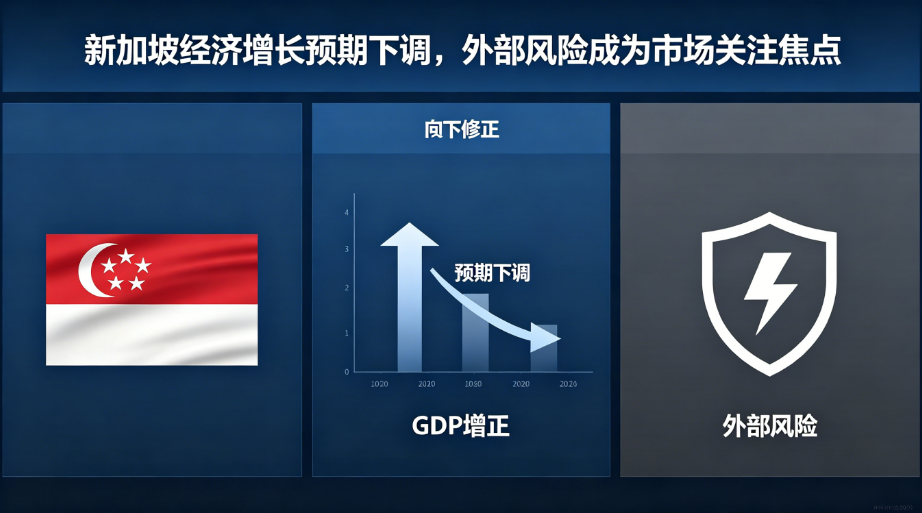
In 2026, Singapore's economic growth forecast is undergoing a subtle but significant adjustment. According to the latest survey report by the Monetary Authority of Singapore (MAS), economists have slightly lowered the country's 2026 economic growth forecast from 3.6% to 3.5%. This change of only 0.1 percentage point seems trivial on the surface, but like a pebble thrown into a calm lake, it sends ripples reflecting deep market concerns about rising global economic uncertainty.
Singapore, known as the "bellwether of the Asian economy," has long occupied a unique and critical position in the global economic landscape due to its open economic system, efficient policy execution, and stable financial environment. However, when external risks gather like dark clouds, even the most resilient economy must face challenges. This article will analyze the multiple factors behind this forecast adjustment from a technical depth perspective, exploring how external risks are reshaping Singapore's economic outlook.
1. Micro Logic Behind the Economic Forecast Adjustment
1.1 Quantitative Logic Behind the Forecast Adjustment
The adjustment from 3.6% to 3.5% appears small, but it reflects economists' comprehensive judgment after reassessing multiple variables. In macroeconomic forecasting models, GDP growth expectations are based on systematic calculations of consumption, investment, government spending, and net exports. This downward revision means that, in the collective perception of the expert group, at least one or more core variables have shifted negatively.
Specifically, Singapore's highly export-oriented economy determines that its growth is extremely sensitive to external demand. When the global trade environment, geopolitical situation, and technology investment cycles fluctuate, Singapore's export-oriented industries are the first to be affected, which then transmits to overall economic growth.
1.2 Transmission Mechanism from Micro to Macro
In economic forecasting, forecast adjustments often begin with the accumulation of micro signals. From a decline in orders at the enterprise level, inventory buildup, to supply chain disruptions, and then to macro-level trade growth slowdown and declining investment confidence, this transmission chain is interlinked. In this MAS survey, economists unanimously emphasized "external risks" rather than "internal factors," precisely indicating that Singapore's current economic resilience has not been significantly impacted internally but faces systemic challenges from the external environment.
2. External Risk Matrix Analysis
2.1 Middle East Situation: Trigger for Energy Price Volatility
The ongoing escalation of geopolitical tensions in the Middle East has become one of the most impactful risk sources for the global economy. As a major global energy trading hub and petrochemical exporter, Singapore is extremely sensitive to international energy price fluctuations. Any drastic change in the Middle East situation could lead to violent shocks in crude oil prices, affecting Singapore's inflation levels, trade conditions, and corporate operating costs.
More notably, uncertainty in the Middle East is not limited to energy prices. It also affects risk appetite in global financial markets, leading to increased volatility in capital flows and impacting Singapore's stability as a regional financial center. The long-term and complex nature of geopolitical risks is reshaping the global economic landscape, forcing Singapore to reserve more room for response in policy-making.
2.2 Phase Adjustment of AI Investment Craze
In recent years, artificial intelligence technology has sparked an investment boom globally. Singapore, with its advantages in semiconductor manufacturing, electronics, and high-value-added manufacturing, has become an important part of the AI supply chain. However, the survey noted that the global AI investment craze may experience a phase adjustment, and the impact on Singapore's economy should not be underestimated.
From the perspective of the technology lifecycle, AI investment is in a transition from "overheated expansion" to "rational adjustment." The gap between short-term capital market hype and long-term technological maturity may lead to cooling or partial contraction of the investment bubble in AI-related fields. For Singapore, this means that demand for AI-related electronic components, semiconductors, and high-end manufacturing equipment in its export structure may slow down, affecting manufacturing output growth.
2.3 Multiple Impacts of Energy Price Volatility
Energy price volatility not only directly impacts manufacturing cost structures but also affects Singapore's economy through trade channels, inflation transmission, and investment confidence. As an economy highly dependent on international trade, rising energy prices will increase transportation costs, squeeze corporate profit margins, and may lead to a contraction in global trade volumes. In particular, Singapore's chemical and refining industries are energy-intensive, with profitability highly correlated with international crude oil prices; price fluctuations directly transmit to corporate performance and investment decisions.
3. Structural Resilience and Vulnerability of Singapore's Economy
3.1 Internal Support from Manufacturing and Electronics Industry
Despite heightened external risks, the MAS survey still shows that Singapore's economy performed resiliently in the first quarter of this year, with manufacturing, electronics, and export activities supported by AI industry demand. Behind this is the structural advantage Singapore has accumulated in high-end manufacturing over the long term. Its precision engineering, semiconductor manufacturing, and biomedical industries have formed complete supply chains and strong technical barriers; short-term external fluctuations are unlikely to shake its core competitiveness.
3.2 Exposure of Vulnerability in Foreign Trade
However, the openness of Singapore's economy also means its vulnerability is more pronounced. When policy directions, trade order, and geopolitical patterns of major global economies change, Singapore's trade volumes, supply chains, and financial markets are often the first to feel the impact. Since 2024, Singapore's export growth has fluctuated, reflecting global demand uncertainty and supply chain restructuring shocks.
4. Outlook and Policy Responses
4.1 Short-Term Response: Risk Prevention and Flexible Adjustment
Faced with accumulating external risks, the Singapore government has demonstrated strong policy flexibility. The MAS may adjust monetary policy, intervene in the foreign exchange market, and optimize capital flow management to enhance financial system stability. Meanwhile, on the fiscal policy front, the government can offset external shocks by increasing infrastructure investment, strengthening social safety nets, and supporting enterprise digital transformation.
4.2 Medium- to Long-Term Strategy: Deepening Diversification and Value Leap
Over the medium to long term, Singapore should continue to promote economic diversification strategies to reduce dependence on single industries or markets. In high-end manufacturing, it should continue to increase R&D investment and enhance technological autonomy; in finance, it should strengthen digital assets and regional financial center development; in services, it should expand high-value-added service exports. At the same time, it should actively participate in regional economic integration processes, such as the ASEAN Economic Community and RCEP, to build a more stable external demand base.
Conclusion
Singapore's economic growth forecast adjustment from 3.6% to 3.5% may seem like a minor numerical change, but it carries deep market concerns about rising global uncertainty. The ongoing tensions in the Middle East, the phase adjustment of the AI investment craze, and violent energy price fluctuations together form the external risk matrix facing Singapore's economy today.
However, as Singapore's past experiences in responding to financial and economic crises have proven, this "Lion City" has the ability to reshape itself in adversity. Faced with external challenges, Singapore does not need to panic but should calmly analyze and precisely implement policies. With strong support from manufacturing and electronics, the wisdom of flexible policy responses, and the path of innovation-driven economic transformation, Singapore is fully capable of hedging risks while seeking new growth points and achieving structural upgrades of its economy.
As the survey reveals, risks are both challenges and opportunities. Singapore's future economic growth depends on how it can find its direction in the fog of uncertainty and turn external pressures into driving forces for structural transformation. This 0.1 percentage point downgrade may just be a necessary adjustment before Singapore's next leap forward.